Getting the Most Bang for Your Remodeling Buck

Tips to get the most bang for your remodeling buck.Sometimes, your home is one of the largest investments in your ‘portfolio’. Whether you are looking to stay in your home for a while or are considering selling soon, it’s important to pay attention to which remodeling projects will help you add the most resale value to your home.

According to the Remodeling 2016 Cost vs. Value Report as compiled by www.costvsvalue.com for the Denver area, these are the midrange projects shown to be the best bets when remodeling. Continue reading

Watch those Medicare Part B & Part D (Prescription Drug Coverage) Premiums: You May be Paying Higher Premiums than you Should!

Sharkey_Howes_Javer_Glasses_Monthly_Adjusted_BlogFor our seniors 65+ and those caring for seniors…

Did you know that if your income has dropped significantly you may be eligible for a reduction of your Medicare Part B & and Part D (Prescription Drug Coverage) premiums?

If you’ve ever received a letter from Social Security telling you that your income level causes you to pay extra premiums on your Medicare Part B and Part D, then you should be aware of these rules.

The Social Security Administration receives data that is two-years old, specifically your Modified Adjusted Gross Income (MAGI), each year from the Internal Revenue Service (IRS) and uses this information to determine the amount of your monthly premiums. If your income has dropped below specific thresholds, your premiums will decrease and vice versa. See the chart below for a breakdown of income levels and premiums required in 2016.
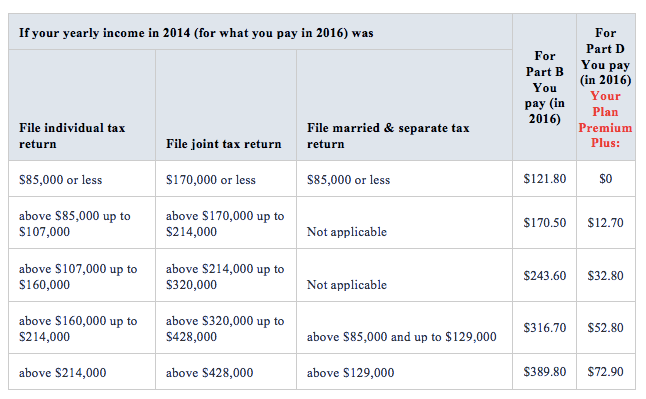
SHJ Tax Return Comparison Chart(source)

The important thing to note is that you don’t have to wait for two years for Social Security to get updated information from the IRS. Instead, if you know your MAGI has dropped below the income threshold on which your current premiums are based, then you can file an appeal along with some required documentation of your current MAGI and request a review.

Required documentation is:

  • A copy of your filed tax return and an IRS transcript;
  • A letter or statement from the IRS stating they have corrected your tax information and explaining the correction;
  • Your amended tax return, along with a letter from the IRS accepting your amended return or an IRS transcript; Your copy of your tax return that shows an obvious IRS transcription error in tax-exempt interest income; or
  • Your declaration under penalty of perjury that you lived apart from your spouse for the entire year when you filed your income tax return as “married Filing separately”. (source)

If the Social Security Administration finds that you’ve been paying a higher premium than you should have been, then they will refund the excess within 30 days of notifying you of their findings. So don’t wait, keep an eye on your income level and if you’re due a reduced premium, get filing!

For additional information read publications, Medicare Premiums: rules for Higher-Income Beneficiaries (SSA Publication No. 05-10536) and Medicare Premiums: What You Can Do If you Think Your Income-Related Premium Is Incorrect (SSA Publication No. 05-10125).


Fee-Only Advisors: What are you actually paying for?

Financial consultant reviewing statistical graphs and charts

Oftentimes, making financial decisions can be overwhelming and emotional. In a world inundated with information via the internet, it can be hard to make heads or tails of it all. Working with a financial advisor can provide direction and peace of mind when making decisions, but how do you find a relationship that you can trust?

A good place to start is asking how the advisor is compensated. Working with a fee-only advisor can largely impact the services you receive. A fee-only advisor is paid by the client for the advice they give, not by product sales or commissions. This fee is typically on a project, hourly or retainer basis, or a percentage of assets under management. Be careful not to confuse fee-only with fee-based, which can include a client fee and commission component. Continue reading

The Top 3 Advisors You Need for Optimum Financial Health

SH&J Top Three Advisors Your Need in Your LifeThroughout the course of our lives we often find ourselves in need of the benefits various advisors provide. In the realm of finances, there are three types of advisors we see as invaluable to your long term financial health.

1. Estate Planning Attorney
A recent Gallup poll found only half of Americans have created a last will and testament (source). Furthermore, estate planning services seem to be a dime a dozen from cheap online solutions to attorneys who draft the same plan for every client.

Estate planning is often misunderstood. It involves much more than paying estate taxes. Estate planning done well allows you to provide guidance to and appoint person(s) of your choosing to make healthcare and financial decisions on your behalf in the event of your incapacitation and may help ensure that your assets are divided amongst heirs as you desire. Building a relationship with a reputable estate planning attorney who understands your unique situation not only makes sense for you, but it also can help offer your loved ones peace of mind that you have a plan in place. Continue reading

Family Dynamics: Financially Assisting Adult Family Members

Sharkey Howes & Javer Financially Assisting Adult Family MembersProviding financial assistance to adult family members, while sometimes very helpful, may also create conflicts. As Certified Financial Planners ®, our clients often ask us to help them work through such issues. When working with clients who find themselves in the midst of a difficult family dynamic involving money, our process is to help our clients understand the impact of providing financial assistance to adult family members. Below we share a few of the conflicts we have found (Please note: identifying information has been changed for privacy purposes). Continue reading

How to Responsibly Handle Your Tax Refund

Tips to responsibly handle your tax return.

It’s tax season and for almost 80% of Americans, (source) a refund check may be in the mail. It’s easy to view a tax refund as free or easy money, but remember you worked hard to earn that money. Using your tax refund responsibly now can assist in reaching your financial goals in the future.

Here are 8 suggestions for using your tax refund responsibly:

Top Off Your Emergency Fund
An emergency fund is an important part of any smart budget. If your emergency fund has been depleted recently, think about using your tax refund to top it off. Depending on the circumstances, we typically recommend having an emergency fund that covers three to six months of basic living expenses.

Build Your Investment Portfolio
Consider using your tax refund to add to your investment portfolio. Talk to your Certified Financial Planner® about how to allocate your tax refund dollars amongst your investments. Continue reading

Should I Live for Today or Save for Tomorrow?

SH&J Live for Today or Save for Tomorrow?There seems to be conflicting advice in modern media. On one hand, there are plenty of articles stating the importance of saving money. On the other hand, there is an emergence of articles encouraging living for today and letting the money “work itself out later”. This leaves the audience confused and internally conflicted. Should I live for today or save for tomorrow?

The answer can be deeply personal, and while your family or advisor may offer advice, ultimately the decision is yours. It is no secret that life can be short and there is no guarantee of tomorrow. Embracing and living every day to the fullest can be vitally important for your emotional and mental health. Spending your hard-earned money to travel, further your education, pursue a hobby, support a loved one, or explore your creative mind may provide much more personal fulfillment now than building a savings/investment account for your future. Continue reading

You Purchased a Timeshare, Now How Do You Get Rid of It?

Starkey, Howes & Javer Selling Timeshares

If you have ever traveled to a resort associated with a timeshare, it’s likely you have been approached with a presentation about timeshare ownership. You’ve enjoyed the amenities and accommodations throughout the week and daydream about how nice it would be take a similar vacation every year. Timeshares give you the ability to return and relive your travel experiences or, for an additional fee, you may opt to exchange for a different resort location expanding your vacation options. You are able to enjoy home-like accommodations and your long-term savings over hotels may even outweigh the upfront purchase price. Many are drawn to the appeal of owning a timeshare; however, once purchased, you own an asset that could become more of a hassle than you originally planned for.

Over time, your situation may change and you may find that you are unable to use your timeshare as much as you would like. At that time, you may want to sell it or simply walk away. Or perhaps you have enjoyed your timeshare for many years and have no plans to sell, but start to wonder, “What will happen when I pass away?” Continue reading