2015 Q1 Quarterly Commentary

“March Madness isn’t just for basketball anymore”

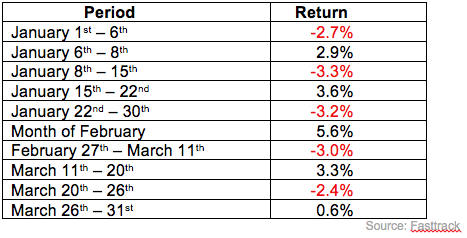
We experienced lots of thrilling and unnerving action both up and down the court in the markets. At year-end 2014, the S&P 500 was the All-star and International positions were the under achievers. The opposite proved true in the first quarter of 2015. The chart below captures the S&P 500’s volatility during various periods as it rotated between winning and losing for an overall quarterly return that was just under 1%. Lots of action – not much traction!
Screen Shot 2015-04-13 at 11.18.43 AM

Uncertainty around the interest rate policy of the Federal Reserve has contributed much to the volatility. Fed Chair Janet Yellen’s last statement announced, unhelpfully, that the Fed is “data dependent” and the pace of interest rate increases could “speed up, slow down, pause, or reverse.” The main driver of the stock market is always corporate earnings, rather than political or media pronouncements. The strengthening U.S. dollar hurt U.S. companies’ foreign earnings, which were down 5.3% in the 4th quarter 2014. A strong dollar makes U.S. purchases abroad cheaper and foreign purchases of U.S. products more expensive. Most of the companies in the S&P 500 receive at least 50% of their earnings from abroad.

The current volatility brings back memories of how terrified Americans were in 2008 when the S&P dropped 37%. It is a test of resolve to follow Warren Buffet’s advice to “buy when others are fearful” – a methodology that works! Yes, such opportunities are fearfully predicted and always unpleasant, but in retrospect every market correction stabilizes over time.

It begs the question: if downturns produce great buying opportunities, why are we afraid of the next one? Having well balanced portfolios and enough cash for current needs, allows us to stay the course during market corrections knowing that the investments will support your spending needs for many years beyond today’s headlines.

Our technical indicators are showing weakness in the emerging markets asset class, so we will immediately reduce those respective allocations by up to 25%.

The chart below reflects the performance of various indices over the past quarter.Screen Shot 2015-04-13 at 11.20.14 AM
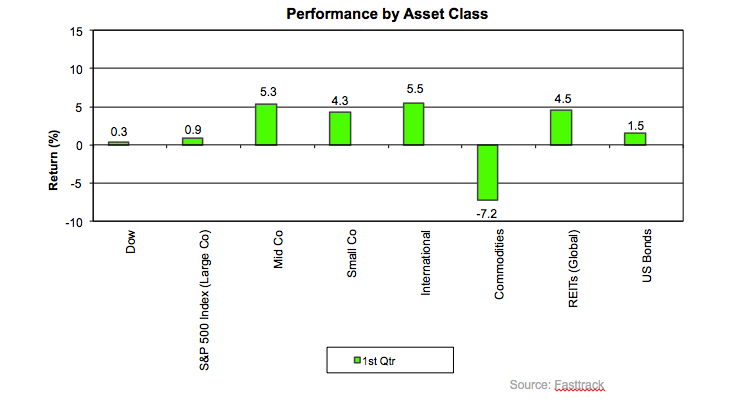
The chart shows that even in a poor quarter for the S&P 500 other categories mostly did well – a March “win” for asset allocation and proper diversification.


SH&J Happenings

On our website (shwj.com) every other Thursday we post our most recent economic discussion from our Investment Committee meeting. Just click on “Blog” in the upper right hand corner to listen in.

Our offices will be CLOSED Monday, May 25th for Memorial Day and Friday, July 3rd for the July 4th holiday.

We will continue our tradition of closing our office at 1pm each Friday from Memorial Day to Labor Day so our hardworking staff can take advantage of the lovely Colorado summer! Of course we will be available if you need us, yet we would appreciate your calls on Friday mornings if possible.

The SH&J Team

Tell me about your investment process

Karlton does an excellent job of summarizing our investment process in the video above. The investment process with us is more than a onetime event, it is an ongoing process.

The process looks like this:

  • Define Goals and Objectives
  • Set Portfolio Expectations
  • Determine Asset Allocations
  • Monitor Investments
  • Review Regularly

We never consider our investment process to be ‘finished.’ Your circumstances change over the years and we will make sure we keep the process going to keep your portfolio on track. We’d love to set up a complimentary consultation for you to come in and learn more about our investment process and SH&J philosophy. Give us a call today at 303.639.5100.  

Inside the Economy with SH&J: March 30, 2015

We’re back from our brief hiatus and have some interesting topics in this week’s discussion. Listen in to hear some insights into Japan’s economy, the good news for Americans and their savings as well as an update on the Eurozone and Greece. We look forward to hearing your comments and questions in the comments section below!

Why are you fee-only and what does that mean?

Team
Why are you fee-only and what does that mean?

We are often asked about our decision to be a fee-only financial planning firm. The term ‘fee’ occasionally throws people off, and we thought we should share about our decision and how it benefits our clients.

When we started the firm in 1990, we made the decision that we didn’t want to be bound to commissions. We wanted the freedom to make decisions based on the unique needs and goals of our clients. In short, we decided to be fee-only before fee-only was cool.

At the most basic level, fee-only simply means we are compensated solely by our clients, not by commission. As fee-only planners, we don’t earn commission from sales and we do not sell our clients products. Instead, we are required to act in the best interest of our clients — an important distinction.

At SH&J, we are paid by a percentage of the money under our management, and a flat fee for financial planning. In essence, our clients pay for our advice and our responsible investment management.

As fee-only planners, we are also proud members of NAPFA, the National Association of Personal Finance Advisors. You can read more about NAPFA standards here. We think the Wall Street Journal summarized their standards and fee-only planners well when they said, “They accept no commissions at all and pledge to act in their clients’ best interests at all times. In many respects, NAPFA standards meet or surpass the requirements needed for a CFP credential,” source.

We’d love to meet with you to talk more about our firm and discuss how we can partner together to help you plan, invest and succeed. Contact us today >

Meet Amy Geist

AmyName: Amy Geist

Title: Client Service

SH&J team member since: November, 2014


As the newest team member of SH&J, what have you enjoyed most about working here so far?

I’ve enjoyed getting to know the team and everyone’s diverse backgrounds and knowledge.   I’ve been impressed with SH&J’s culture and everything we stand for. It’s been rewarding to be a part of something so grand.

We hear you love to cook. What’s your favorite meal to make?

I enjoy cooking almost anything as long as it’s for great company. I believe food brings people together and forces them to interact and communicate. My favorite meal to make is Thanksgiving dinner with my mom. I usually go to her house in the morning and we watch the parade while we make stuffing, spaetzles, and the usual traditional family recipes. Having people enjoy something you made is so rewarding.

If you could have any super power what would it be?

I would have the power to create a soundtrack based off of what was happening at the time. I think the ability to have a certain song play that corresponds with an occurrence would highlight and deepen it. Just like it does during a movie, but it would be for life in general.

What’s the best thing you have ever gifted to someone?

I think the best gift you can give someone else is the gift they wouldn’t think of or buy themselves. The thought and meaning behind the gift is ultimately what it’s about. Every year I used to buy my dad a gift but would always feel like I could do better, so a few years ago I baked him cookies and mailed them to him. He was so excited and surprised and now he asks for them every year instead of me buying him something else. Sometimes the littlest things have the biggest impact.

If you could do anything, and money wasn’t a factor but you still had to work, what would you do?

I would assist local animal shelters and organizations. I am a huge animal lover and believe you should help those who do not have a voice to help themselves.

Inside the Economy with SH&J

Economic_ScreenshotOur economic discussions are on a temporary hiatus this month which gives you some time to catch up! You can view the whole library of discussions on our website.

While we are on hiatus, we would still love to hear from you.

What questions do you have about our discussions? Is there anything specific you would like us to touch on in future discussions? Please share your comments below!

Thanks for continuing to tune in. We will be back with a new discussion the week of April 13th.

5 Personal Finance Tips for Everyone

Brown Wallet with credit cards and dollar banknotes over woodenPersonal finance is important whether you are just starting out or have been in the game a while. Here at SH&J, we know how you manage your personal finances directly impacts the success of your complete financial plan. We’ve pulled together five tips anyone can use to help manage their own finances.

  1. Start Early
    There’s no time like the present to start working on your personal finances. The sooner you start saving and investing your money, the better off you will likely be in the long run. Seek advice from a Certified Financial Planner™, read books and blogs on finances to gain knowledge, and find tools to help you stay on track. We also recommend talking to your kids about money from an early age to help set them on the right financial path.
  1. Know Where Your Money Goes
    Have you ever come to the end of a month and wondered where your monthly paycheck really went? If so, you’re not the only one. Staying on top of your personal finances means paying attention to where your money goes. Find a system that works for you. Some prefer online tools for tracking expenses, while others need to carry a notebook and write everything down. Whatever the system, make sure you pay attention to how your money is being spent.
  1. Learn Self Control
    At any age or stage of life, it can be difficult to say no to the vacation, night out on the town or those new shoes. But, the practice of self-control can lead to much greater monetary achievements. When you really want to purchase an item or experience, give it a couple of days before pulling the trigger. Consider whether what you want is really what you need, and how your decision will impact your long term goals. By learning to delay unnecessary purchases, you may free up more money to save and invest elsewhere.
  1. Simplify Your Life
    It’s easy to get caught in the race to keep up with the Joneses – a bigger house, the newest car model, the latest fashion. Rather than trying to keep up, simplify. Warren Buffet, one of the world’s richest men, still resides in the home he bought in Omaha, Nebraska in 1957 for $31,500 (source). When it comes to finances, focusing on the big picture, while keeping your life as simple as possible, often leads to greater success.
  1. Take Control
    Instead of being a passive bystander, take the reins of your personal finances. Build a team you can trust, from your banker to your financial planner to a trusted friend or family member, people who will hold you accountable. Stay in touch with your team, and pay close attention to the information they send you such as quarterly reports. Take an active interest in not only where your money goes, but also how it grows.

Personal finances can be tricky at times, but with the right tools and a commitment to seeing your goals come to fruition, you can find financial success. Take our tips and implement them into your personal finance strategy. If you need help creating a more in-depth financial plan, we’d love to talk. Reach out today.

Inside the Economy with SH&J: March 2, 2015

As we head into the Spring, Larry brings us up to speed on energy and the economy, including a fascinating look at the new Harriet Jet Turbine by GE. We also get an overview on various types of loans, population and it’s relation to economics, as well as an update regarding the European Central Bank’s decision on Greece.

How do you manage investments?

Great relationships are formed by taking time to get to know each other. That’s exactly how we start our investment management process with you.

We want to:

  • Learn about who you are
  • Discover your goals
  • Understand your risk tolerance


As Stephen said in the video, “We know our clients are unique and canned plans just don’t fit.” So once we have gotten to know each other, we begin building a customized portfolio.

Our portfolios typically include:

  • Mutual Funds
  • ETFs
  • Individual Stocks and Bonds

After we have built your portfolio, we continue to monitor your investments. We meet regularly to take a hard look at market trends and the global economy. We work on your portfolios as a team in order to make the best possible decisions with our client’s investments.

As the years go by and circumstances change, we will continue to meet with you to update your goals and make changes to your portfolio. Our goal is to not only have you as a client, but also as a friend.

If you’d like to learn more about our investment management process or our other services, please give us a call at 303.639.5100.